
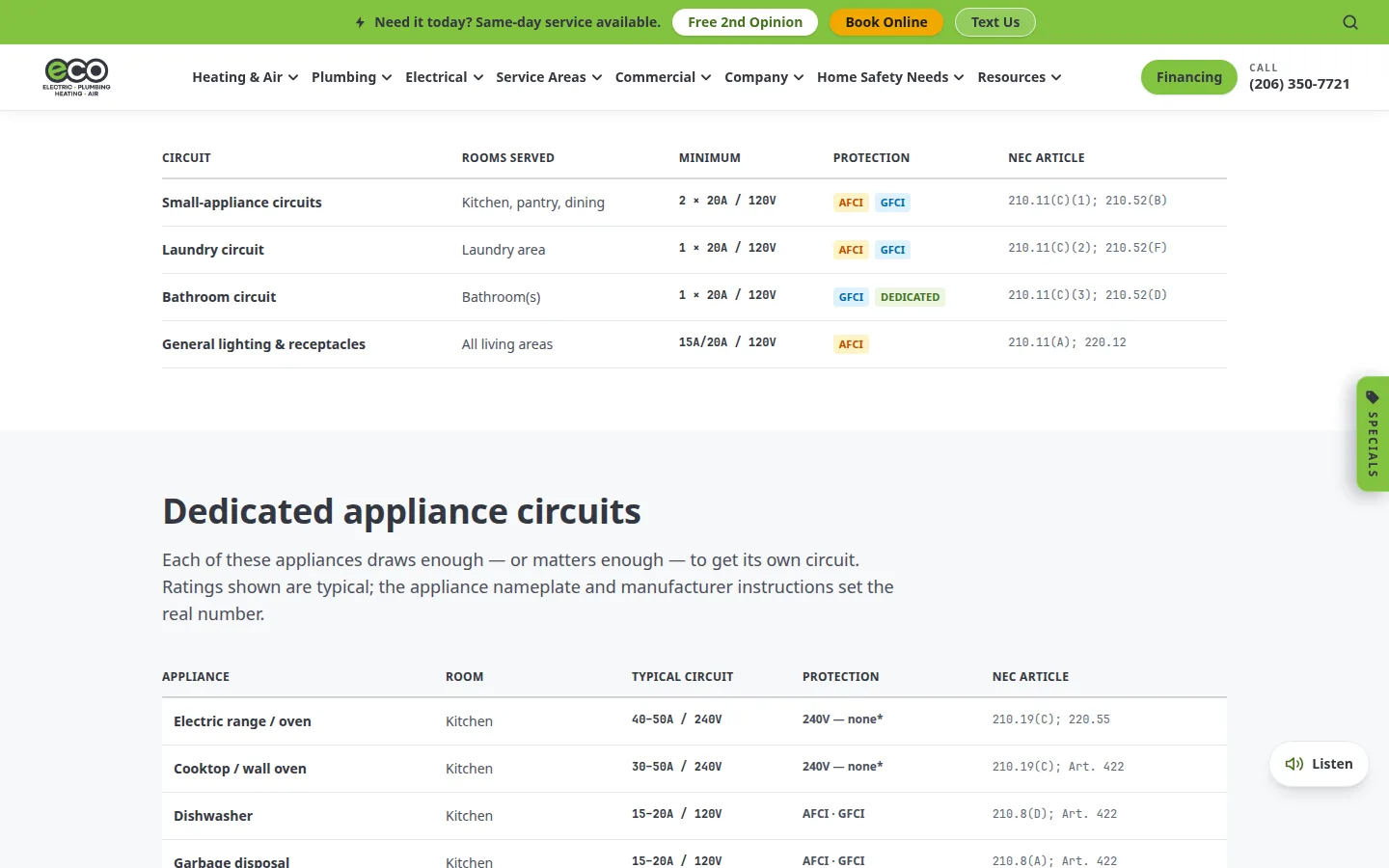
Quick answer: the Home Circuits Explorer is an interactive map of the circuits in a home — what's on each breaker, what needs AFCI or GFCI protection, what trips and why — published as a guide page on your site. It captures question-shaped searches, earns AI citations, and feeds panel-inspection leads. Tour it live on Eco Electric, Plumbing, Heating & Air's site: ecoserviceswa.com/home-electrical-guide — then order it from the Component Store. This is the first post in our Component Deep Dive series: one component at a time — the mechanics, the performance math by pillar, and the honest answer to when it belongs in your order.
What it is, mechanically
The Home Circuits Explorer is a Hydra Build Component in the Education category. On the page, a homeowner clicks through the rooms of a house — kitchen, laundry, bathroom, garage, bedroom — and sees the circuits behind each one: the breaker size, whether the circuit is shared or dedicated, the protection the electrical code expects (AFCI, GFCI, or both), and the NEC article that says so. Around the interactive sit reference tables: required circuits by room, dedicated appliance circuits, and a plain-language explainer of why breakers trip.
Two engineering details do most of the work:
- Every table row is an answerable fact. “A bathroom circuit is 1 × 20A / 120V, GFCI-protected, dedicated — NEC 210.11(C)(3).” That single row answers “does a bathroom need a dedicated circuit?” completely. Pages built from answerable facts are exactly what featured snippets and AI answer engines quote.
- The facts are structured, not just prose. Rooms and circuits render as structured content that machines can traverse — which is what makes the component agent-actionable (more on AXO below).
Performance really has two sides
Pages like this help both — when they're built the way this one is.
Search performance: why the page ranks
- It captures question-shaped searches. A page titled “Which circuits does your home need?” matches how people actually search — “does a dishwasher need a dedicated circuit,” “AFCI requirements bedroom.” Each table row is an answerable fact, which is exactly what Google's featured snippets and AI answer engines pull from. That's the Intent-1 Learn tier in our content architecture: it brings in homeowners who aren't searching for an electrician yet — so you meet them before your competitors do.
- It feeds the internal link graph. The guide links out to the load calculator, the panel-cost page, and the service pages — and receives links from the Learning Center, the mega menu, and brand pages. That mesh passes authority to the conversion pages and keeps crawlers (and users) moving instead of hitting a dead end.
- It builds topical authority. A cluster of genuinely useful electrical guides — circuits, load calculator, panel costs, electrification — tells search engines the site is an authority on residential electrical. That's what lifts the money pages (“electrical panel replacement Seattle”) that are otherwise very hard to rank.
Business performance: why the page converts
- Interactivity increases dwell time and reduces pogo-sticking. Someone clicking through rooms in the circuits explorer stays on the page, scrolls further, and is far more likely to hit the “not sure what your panel has?” CTA. Engagement signals like that correlate with rankings — and dwell time directly correlates with conversion.
- It manufactures the next step. The guide's natural exits are commercial: book a panel inspection, run the load calculator, price a panel upgrade. Education that ends in a booked truck roll isn't a cost center.
What it does, pillar by pillar
- SEO — long-tail question coverage, internal-link equity to money pages, and cluster-level topical authority. KPI: electrical-guide traffic and the rankings lift on panel/service pages.
- AEO — answerable facts with code citations are citation bait for answer engines; this is the page ChatGPT quotes when someone asks about bedroom AFCI requirements.
- GEO — generative engines assemble answers from sources they trust; structured circuit facts with NEC references give them something concrete to attribute — with your brand attached.
- SXO — the search-to-satisfaction journey ends on-page: the searcher gets the answer, the visual explorer, and the next step without pogo-sticking back to results.
- AXO / AAO — room and circuit facts render as structured content AI agents can traverse. When an agent shops “electrician who explains AFCI requirements,” your site is machine-legible.
- E-E-A-T — code-accurate tables citing NEC articles demonstrate expertise on exactly the questions licensing boards care about; guides like this also earn editorial links no service page ever will.
- Core Web Vitals — built on the Hydra OS static architecture: the interactive hydrates as an island, so the education page ships fast and stays green. Education never comes at the cost of your performance scores.
- CRO — the explorer's dwell time warms cold traffic, and the “book a panel inspection” CTA converts it. KPI: inspection leads attributed to the guide.
- LSO — pair it with service-area pages and the guide becomes the authority spine behind “electrician near me” — the map pack rewards sites that answer like the authority.
See it live, then see the SKU
The production example featured in this post runs on Eco Electric, Plumbing, Heating & Air — the Puget Sound multi-trade brand whose launch story includes a follow-up AI audit ranking the site in the top 1% nationally for home-services website architecture. Their electrical guide is the pattern this component productizes: room-by-room interactivity, code-cited tables, and commercial exits.
In the Component Store, the Home Circuits Explorer ships priced on request (it's tailored to your trade mix and market), tier-1 performance class, with published KPIs: electrical-guide traffic, AI citations, and inspection leads. Buy it, we build it into your brand, it ships in days — the full catalog guide explains the model.
When should you add it? Sequence beats enthusiasm
Money doesn't grow on trees — and components pay off fastest in the right order. The 12-step results roadmap runs Infrastructure → Marketing → Conversions → Training & AI Ops, and education components like this one live in the Marketing phase: they're traffic builders. The sequencing logic in plain terms:
- No site or a just-launched site? Foundation first. Education components inherit their speed and link mesh from the platform under them — and your launch tier already includes core components.
- Live but thin traffic? This is the moment. Learn-tier education builds the audience and the authority your money pages need. Add the Circuits Explorer now.
- Traffic strong but conversions lagging? Spend the marginal dollar on CRO components first — estimators, financing calculators, booking flows — then circle back to education next quarter.
- Converting well? Compound the margin with agent-actionable operations components, and let education keep compounding in content waves.
Find your own stage in the interactive roadmap below — it gives you the honest verdict for this component and what to buy instead if the timing's wrong.
Find your place on the 12-step roadmap.
Money doesn't grow on trees — components pay off fastest in sequence. Pick the answer that sounds like your shop and get the honest verdict, including whether Home Circuits Explorer belongs in your next order.


