
Quick answer: Hydra OS just released its expanded Central Intelligence engine — and the upgrade is a change of kind, not degree. The Central Intelligence Center used to be a set of structured fields you filled in. It is now also an Obsidian-powered knowledgebase: a living, cross-linked graph of your business — identity, operations, catalog, market, economics, proof, marketing, and goals — that Hydra's AI agents, content generation, campaign work, and local SEO all read from. Fields tell a system what to render. A knowledge graph teaches it why.
What is the Central Intelligence engine?
Every client on Hydra OS has a Central Intelligence Center — the single place where the platform keeps what it knows about your business. Until now, that knowledge lived mostly as structured fields: your phone number, your service areas, your brand colors, your feature flags. Structured fields are excellent at powering templates. They are terrible at answering questions like “what does this company refuse to do?” or “how should an emergency page sound different from a maintenance page?”
The expanded engine adds the layer that was missing: a per-client knowledgebase built on the same foundation as Obsidian — markdown files, connected by bidirectional links, forming a graph a machine can walk. Your services link to the products behind them. Your cities link to the community work you do there. Your referral program links to the partners it pays. When an AI agent needs context, it does not get a database row. It gets the neighborhood around the answer.
Why Obsidian-style linking matters for a trades business
Obsidian became the tool of choice for researchers and writers because of one idea: knowledge is not a list, it is a web. The [[double-bracket]] link turns isolated notes into a graph, and the graph is where the compounding happens.
Apply that to a home-service company. Your Daikin dealer relationship is not one fact — it touches your product lines, your warranties, your financing offers, your technician certifications, and the manufacturer pages on your website. In a fields-only world, those live in five disconnected boxes. In the knowledge graph, they are one connected story — and when Hydra generates a service page, a blog post, or an answer for an AI search engine, it can follow the links and get the whole story right.
This is the same principle we published in our Open Knowledge Format guide — machine-readable, linked markdown is how you make a business legible to AI. The expanded Central Intelligence engine applies it to every client's private knowledge, not just our public site.
What feeds the engine? The 21-file business brain
The intake for the new engine is the Hydra Business Intelligence Specification (HBIS) — an Enterprise Obsidian Vault of 21 markdown files covering every dimension of the business, organized in four parts: core identity & operations, catalog + market + economics, proof + marketing + performance, and brand + goals.
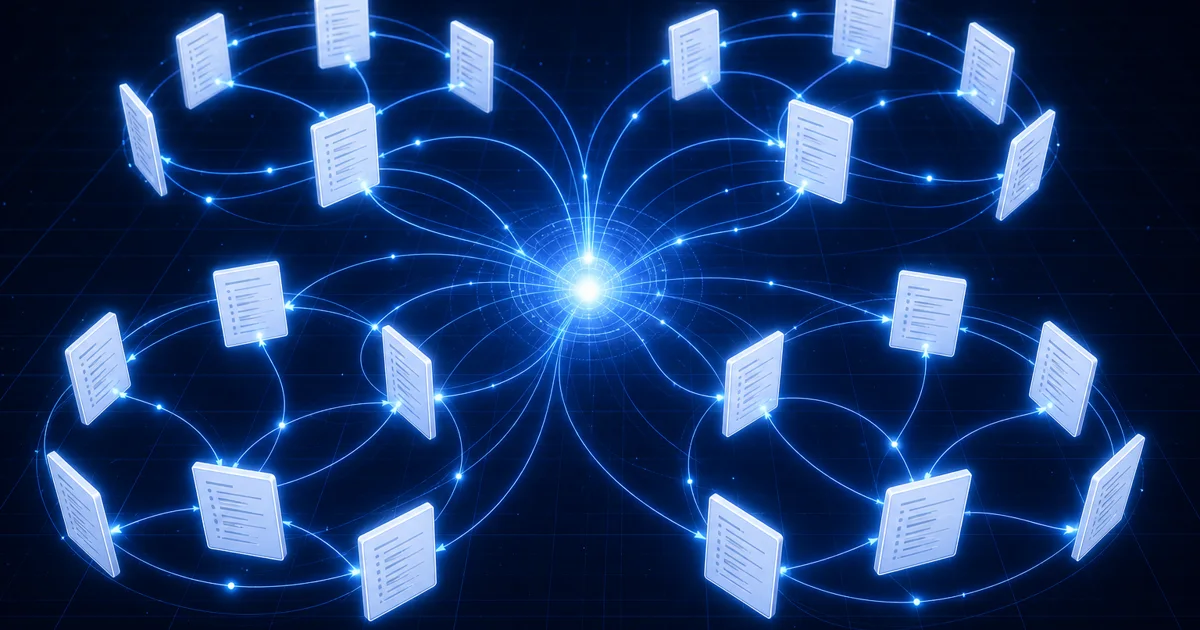
Entity, Soul, Systems, Sales, People, Partners, Services, Geo, Personas, Economics, Products & SKUs, Memberships & Financing, Referrals & Partnerships, Licensing & Certifications, Press & Media, Community Impact, Marketing Calendar, Paid Ads, Analytics, Conversions, and Brand & Directives. Every file carries required sections, and every claim traces back to something real — anything the intake can't verify is flagged [Missing] rather than invented. We wrote the no-guessing rule into the specification itself, because a knowledgebase with invented facts is worse than no knowledgebase at all.
The deep-dive on all 21 files is here: Inside the Hydra Business Intelligence Specification.
What does the engine power?
- AI agents — when Hydra's agents draft a page, answer a question, or plan a campaign, they retrieve from your graph, not from a generic model's imagination.
- Content generation — blogs, service pages, and city pages that carry your real voice, your real proof, and your real service promises, because voice and proof are files in the vault.
- Local SEO — per-city knowledge (permits, utilities, housing stock, community work) becomes per-city content and schema, which is the substance behind the LSO components.
- AI search visibility — answer engines reward businesses whose facts are consistent and connected everywhere they look. A graph enforces that consistency at the source. (This is the shift we documented in The Measurement Shift.)
What happens to the fields?
They stay — and they matter. Structured facts (phone, address, hours, license numbers) still live as structured data, because templates and schema need precision. The knowledgebase wraps around them as the training corpus: the stories, systems, preferences, and reasoning that fields could never hold. Both live in your Central Intelligence Center. Facts for the machines that render; knowledge for the machines that think.
What this means if you're a CI Web Group client
Your website stops being the only artifact of your business knowledge — it becomes one output of it. The same brain that builds your site can write your blog, brief your campaigns, answer AI search engines, and onboard the next piece of work without asking you the same questions twice. And the intake to build that brain just got dramatically less painful — that story is here: Less Forms, More Agentic.